Ifejika joyce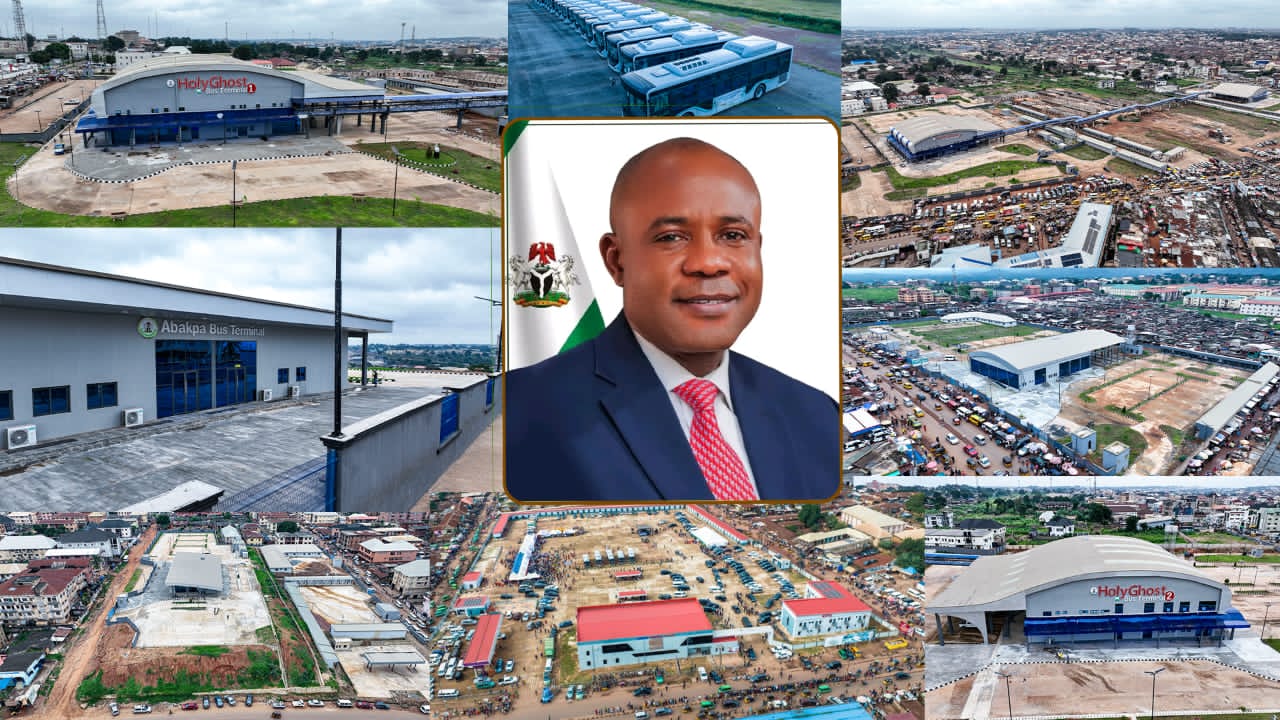
By Nnamani Arinze Darlington
On Thursday, August 14, 2025, Enugu State Governor Peter Mbah launched a groundbreaking initiative that promises to revolutionize transportation in the state, aligning with his vision for a modern, multimodal, and sustainable transport ecosystem. The Enugu State Transport Management System was officially unveiled, accompanied by the commissioning of five state-of-the-art bus terminals and the rollout of 100 Compressed Natural Gas (CNG)-powered buses. This ambitious project, part of the administration’s Phase 1 Integrated Transport Infrastructure Projects, is set to transform mobility, boost the state’s economy, and enhance the quality of life for over seven million residents of Enugu State.
A bus terminal is the point where a bus route starts or ends, where vehicles stop, turn or reverse, and wait before departing on their return journeys. It is also where passengers board and alight from vehicles. A well-built bus terminal, like the ultramodern facility in Enugu, also provides a convenient point from which services can be coordinated to maintain order and ambience in the transportation sector of Enugu State.
Prior to the construction of the modern transport terminals, areas such as Holy Ghost, Gariki, Abakpa, and Nsukka in Enugu State had historically been associated with chaotic traffic, criminality, and general disorderliness, particularly before the significant infrastructural interventions that led to the construction of these terminals. The newly commissioned bus terminals are strategically located at Holy Ghost Terminal 1 (Enugu Central Station 1) for interstate travel, Holy Ghost Terminal 2 (Enugu Central Station 2) for intercity transport, Nsukka Central Station, Abakpa Central Station, and Gariki Central Station. These ultramodern facilities are designed to address longstanding issues such as traffic congestion and disorganized transport systems, particularly in areas like Holy Ghost, which Governor Mbah described as previously synonymous with “chaotic traffic and general disorderliness.”
Each terminal is equipped with world-class amenities, including fully air-conditioned halls, television screens, eateries, lodging accommodations, CNG refueling stations, solar-powered security lighting, surveillance cameras, and sunscreen-covered walkways. Notably, Holy Ghost Terminals 1 and 2 are connected by a 400-meter sky bridge, the longest in Nigeria, enhancing commuter convenience. The terminals also feature food courts, banking halls, motels, shops, and cinemas, transforming them into economic hubs that go beyond mere transit points.
Phase 2 will deliver even more transformative projects, including the 9th Mile Logistics Hub and Central Station, Emene Logistics Hub and Central Station, Obollo Afor Inland Container Hub, Awgu Logistics Hub, and Owo Central Station.
As part of the launch, Governor Mbah introduced 100 CNG-powered buses, out of a planned fleet of 200, to serve as the backbone of the state’s Mass Transit Scheme. These buses are equipped with free Wi-Fi, security equipment, and are designed to be accessible for people with disabilities. The rollout of CNG technology is expected to reduce transportation costs by over 40%, providing a cheaper and more environmentally friendly alternative to traditional fuel-based vehicles. The buses will operate along routes connecting schools, higher institutions, markets, and other key locations, ensuring seamless and affordable mobility for residents.
The Enugu State Transport Management System also incorporates an innovative e-ticketing platform called the Ije Card to enhance transparency and eliminate revenue leakages. Commuters can purchase a single ticket that grants access to multiple buses, with the option to top up as needed. Comprehensive insurance coverage further ensures the safety of passengers.
Governor Mbah emphasized that the transport initiative is a cornerstone of his administration’s goal to grow Enugu’s economy from $4.4 billion to $30 billion within six years. The project is projected to create over 20,000 direct and indirect jobs, spanning bus rapid transit (BRT) operations and 2,000 hybrid city taxis. By stimulating small and medium-sized enterprises (SMEs) and improving connectivity, the terminals and CNG buses will position Enugu as a competitive player in Nigeria’s economic landscape.
The launch of the Enugu State Transport Management System, five ultramodern bus terminals, and 100 CNG buses is a historic milestone in Enugu’s journey toward modernization. By prioritizing affordability, sustainability, and economic growth, Governor Peter Mbah’s administration has set a new standard for public transportation in Nigeria.
*—Nnamani, is the special assistant to governor Peter Mbah on Media*


 Chidiogo asuke