Ugamatv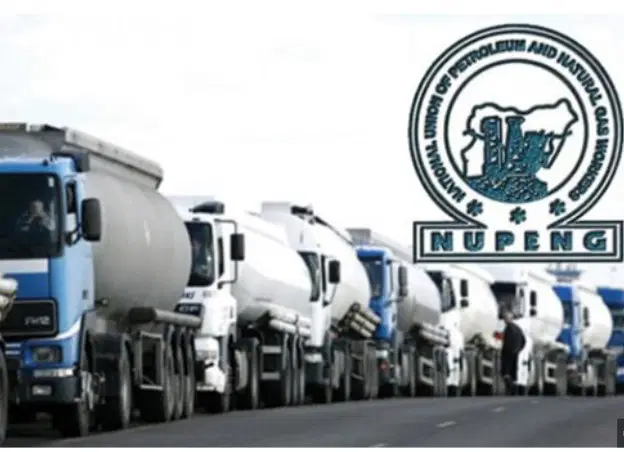
The Nigeria Union of Petroleum and Natural Gas Workers (NUPENG) has reaffirmed its decision to embark on strike action beginning Monday, September 8, 2025, accusing management of Dangote Refinery of attempting to introduce “modern slavery” into Nigeria’s workforce by denying drivers the right to freely associate with trade unions.
In a strongly worded statement issued on Sunday, jointly signed by its President, Williams Akporeha, and General Secretary, Afolabi Olufemi, NUPENG condemned what it described as an anti-labour agenda being implemented by the refinery’s management.
The union had earlier, on Friday, declared its intention to shut down operations nationwide over alleged attempts by Africa’s richest man, Aliko Dangote, to stop newly recruited drivers from joining NUPENG.
The crisis stems from the Dangote Group’s plan to import 10,000 compressed natural gas (CNG)-powered trucks, with the first batch of 4,000 trucks already earmarked for direct fuel distribution to retailers starting from August 15.
NUPENG claims that as part of this distribution model, Dangote has directed that the drivers of these trucks must compulsorily join a new body, the Direct Trucking Company Drivers Association (DTCDA), instead of NUPENG’s Petroleum Tanker Drivers (PTD) branch.
The union described this move as an illegal attempt to bypass Nigeria’s labour laws, undermine NUPENG’s statutory rights, and weaken the bargaining power of petroleum tanker drivers.
In its Sunday update, NUPENG dismissed the DTCDA as a “management-inspired group” created solely to erode the independence of tanker drivers.
“For the information of the public, the DTCDA is the association which the Dangote Group of Companies has formed for the drivers to join compulsorily rather than allowing drivers to join NUPENG, which is the only statutorily recognised union authorised to unionise petroleum tanker drivers,” the statement read.
The union argued that by compelling workers to belong to a company-created association, Dangote was essentially resurrecting slavery under a modern guise.
“Slavery ended centuries ago, but some unscrupulous capitalists are making efforts to bring it back. Any worker who cannot exercise the right of association is no better than a slave. Ordinary Nigerians should neither encourage nor support slavish working conditions,” NUPENG warned.
While NUPENG insists on defending its members’ rights, other stakeholders, including the Petrol Tanker Drivers (PTD) and the Direct Trucking Company Drivers Association (DTCDA), have kicked against the planned strike.
The DTCDA, in particular, argued that it was established to safeguard drivers’ welfare under Dangote’s ambitious trucking scheme. However, NUPENG dismissed the group as a “phantom association” lacking legal backing under Nigeria’s labour statutes.
The union insisted that it alone retains the statutory mandate to unionise petroleum tanker drivers in Nigeria, accusing Dangote of deliberately fostering division among workers to weaken collective bargaining.
If NUPENG goes ahead with the strike, fuel distribution nationwide could be severely disrupted, potentially triggering fuel scarcity and worsening the economic hardship already biting Nigerians.
The strike could also stall Dangote Refinery’s fuel distribution plans, a development with wider implications given the refinery’s expected role in reducing Nigeria’s reliance on imported refined products.
NUPENG stressed that it would remain united and resolute in its mission to defend the rights of workers across the petroleum and gas industry.
“We reiterate our total commitment to the welfare of our members. The union will never compromise on the fundamental rights of workers to freely associate, unionise, and bargain collectively,” the statement said.
The leadership further appealed to Nigerians to understand that its struggle is not only about tanker drivers but also about defending basic freedoms enshrined in the Constitution.
As of Sunday night, there were no indications of fresh talks between NUPENG and Dangote Refinery’s management to avert the strike. Industry analysts fear that unless urgent mediation is initiated by the Federal Government, the strike could escalate tensions in the petroleum sector.
With the refinery seen as a cornerstone of Nigeria’s energy security ambitions, the unfolding labour dispute underscores the fragile balance between big business interests and workers’ rights.
For now, NUPENG insists the strike will commence as scheduled on Monday, September 8, unless Dangote rescinds the directive barring drivers from joining NUPENG and dismantles the controversial DTCDA structure.


 Chidiogo asuke