Precious Chukwuwa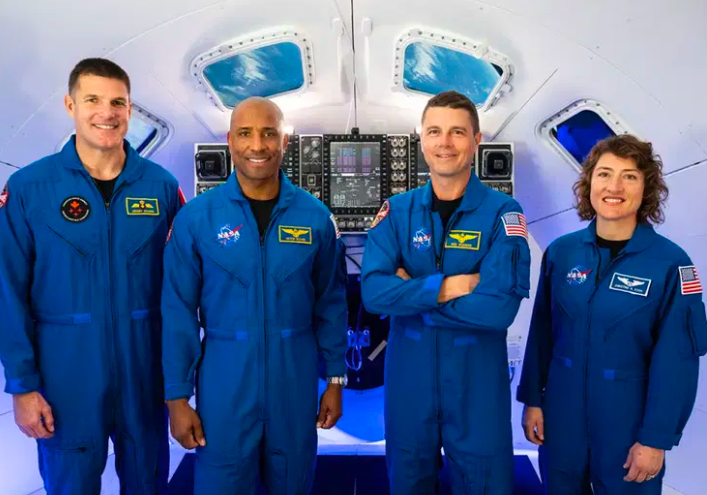
More than five decades after humans first orbited the Moon during the Apollo missions, astronauts on the Artemis II mission are set to revisit the journey—this time using one of the simplest yet most powerful tools available: their eyes.
Despite major technological advancements over the years, NASA continues to depend on human vision to gather valuable insights about the Moon’s surface.
According to mission lead scientist Kelsey Young, the human eye remains unmatched in many ways. She explained that the eye’s ability to process detail, color, and context surpasses that of even the most advanced cameras.
While modern imaging technology excels in certain areas, human vision is particularly effective at interpreting color variations, lighting conditions, and surface textures. For instance, astronauts can observe how shadows and light angles reveal details of the Moon’s terrain—subtle features that are often difficult to capture accurately through images or video.
Astronaut Victor Glover, who will pilot the Orion spacecraft, described the human eye as a “remarkable instrument,” highlighting its importance in space exploration.
To prepare for the mission, the four-member crew underwent over two years of intensive training. The program was designed to transform them into skilled “field scientists,” combining classroom instruction with hands-on geological studies in locations such as Iceland and Canada, along with simulated lunar flybys.
This preparation ensures that astronauts can make the most of their close encounter with the Moon, using both their training and natural observation skills to deepen scientific understanding of Earth’s closest celestial neighbor.


 Chidiogo asuke