Tochukwu Chukwu
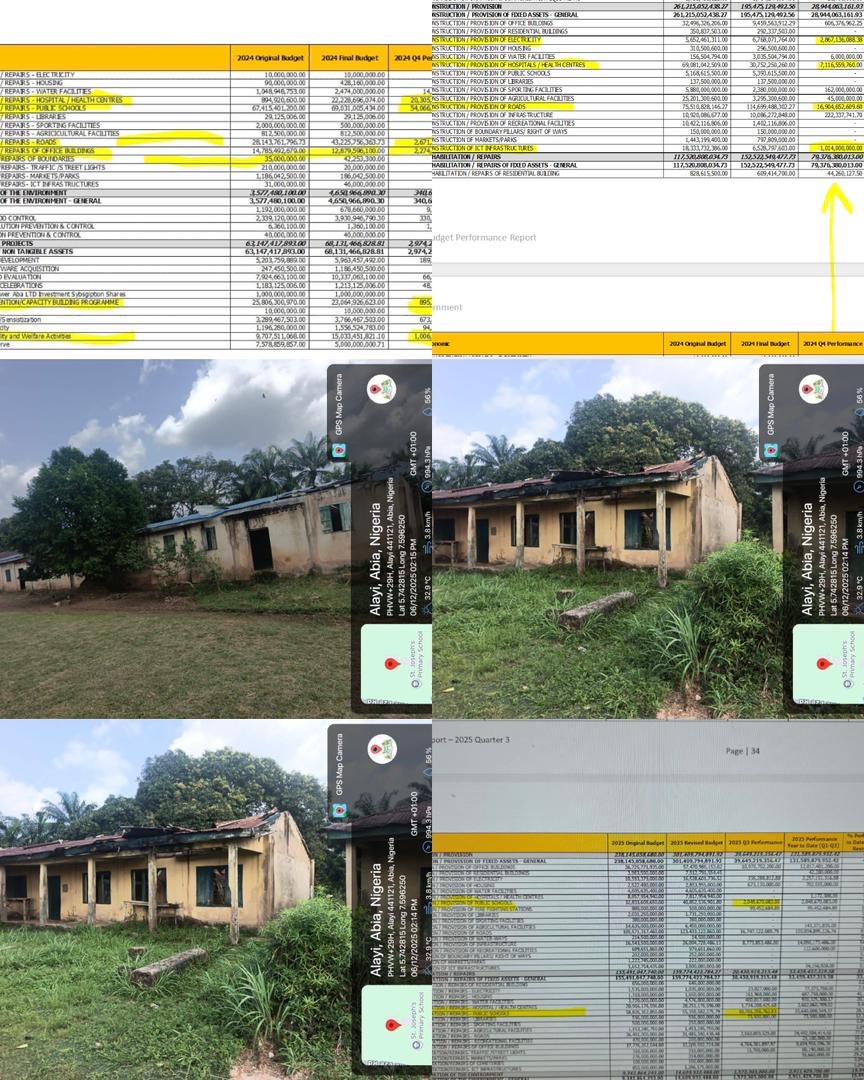
Umuahia — Fresh concerns over transparency and accountability have erupted in Abia State following the release of the state government’s Q4 2025 (October–December) SFTAS Financial Report, which reveals that an additional ₦17.54 billion was spent on repairs of public schools within just three months.
This latest figure adds to an earlier disclosed ₦82.3 billion reportedly expended on school repairs, bringing total spending close to ₦100 billion. When more than ₦8 billion received separately from the Universal Basic Education Commission (UBEC) is included, total public expenditure on basic education infrastructure exceeds ₦108 billion.
Despite the staggering figures, communities across Abia — particularly in Abia North and Bende Federal Constituency — say the reality on ground tells a sharply different story.
Reality Versus Records
Across several localities, what residents describe are not modern learning facilities or newly constructed schools, but rather:
- Dilapidated classrooms
- Abandoned primary school buildings
- Leaking roofs merely replaced with zinc sheets
- Colonial-era structures repainted and rebranded
There is little evidence of new school ecosystems, digital classrooms, or purpose-built “smart schools” frequently referenced in official statements.
A recent photograph from St. Joseph’s Primary School, Alayi, in Bende Local Government Area reportedly shows cracked walls, overgrown surroundings and classrooms deemed unsafe for effective learning. Community members say the condition mirrors that of many public schools across Bende and parts of Abia North.
Questions Over ‘Repairs’
While the Abia State Government has consistently highlighted massive investments in education reforms and smart school projects, citizens argue that visible infrastructure does not support expenditure approaching ₦100 billion.
Education advocates and concerned residents are now raising fundamental accountability questions, including:
- How many schools were actually repaired with nearly ₦100 billion?
- What was the average cost per school and where are the project locations?
- Why do many schools still appear unchanged after decades?
- Why are communities still circulating images of abandoned classrooms?
- Why is there no publicly verifiable list of completed smart schools?
Observers insist these are not partisan or opposition-driven inquiries, but legitimate public accountability concerns arising directly from the government’s own financial disclosures.
Call for Transparency
Stakeholders argue that education infrastructure is too critical to be reduced to accounting figures or cosmetic renovations. They stress that if such significant funds were genuinely deployed in good faith, the government should welcome:
- Independent verification
- Public audits
- Location-by-location project breakdowns
- Transparent publication of completed projects
“Infrastructure does not hide. Schools are visible. Concrete speaks,” a concerned citizen, Janny Ujunwa Lily, noted in a statement.
Until citizens can physically see schools that reflect the scale of reported spending, analysts warn that the gap between official records and lived reality will continue to widen — eroding public confidence and trust.
As public scrutiny intensifies, many Abians insist that clarity, transparency and verifiable evidence are now imperative.
Abia deserves answers. Nigeria deserves accountability.


 Chidiogo asuke