Ugamatv
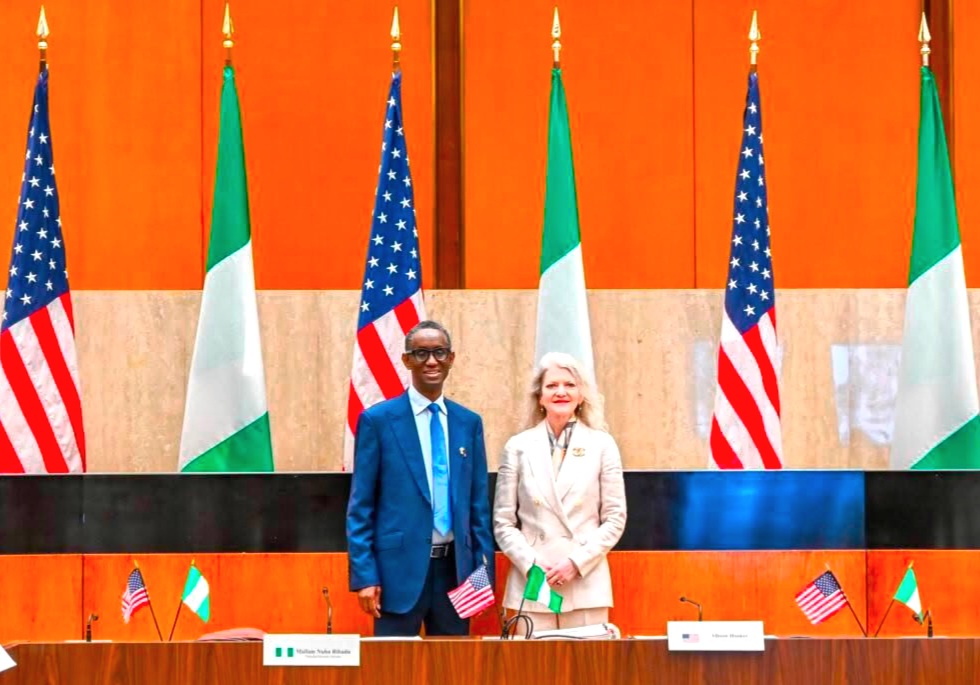
The Minister of Information and National Orientation, Idris Mohammed, and the United States Ambassador to Nigeria, Richard Mills, have jointly clarified the recent US visa restriction policy for Nigerians, stressing that the move is not intended to punish travellers but to strengthen security and improve visa services.
The clarification came on Friday during a press briefing in Abuja, following the US government’s revision of its visa reciprocity schedule for Nigeria. Under the new policy, certain non-immigrant visa categories, including B1/B2 (business and tourism), F (student), and J (exchange visitor), will now be valid for only three months and will allow a single entry.
Ambassador Mills explained that the changes form part of a global review of visa operations aimed at tightening security, improving vetting procedures, and ensuring adherence to US immigration laws. He emphasised that the US continues to welcome Nigerians for study, tourism, business, medical visits, and family reunions, but with a clear expectation that visitors strictly comply with visa conditions.
“If you overstay, it can result in deportation and a lifetime ban on future travel to the US, which we don’t want to see Nigerian citizens face,” Mills warned.
He noted that violations such as overstaying, providing false information, or abandoning academic programmes without proper notification can lead to visa revocation. For student visa holders, he cautioned:
“If you skip classes or leave your programme of study without informing your school, your student visa could be revoked.”
The ambassador revealed that the US is now requiring more rigorous background checks, including access to Nigerian criminal records, to verify applicants’ identities and histories. He said both governments are working on mechanisms to facilitate better data sharing for accurate vetting.
Ambassador Mills encouraged Nigerians to consult the US embassy website for official guidance, assuring that the changes are not punitive but aimed at safeguarding mutual trust and respect between the two nations.
Minister Mohammed welcomed the US embassy’s decision to clarify its policy directly with the Nigerian public, describing it as a step toward greater transparency and understanding.
“This is in no way punitive. It’s just to enhance service delivery between the two countries,” the minister affirmed.
He stressed the importance of mutual compliance with national laws, saying Nigerians must demonstrate patriotism by respecting the laws of other countries, just as Nigeria expects compliance from visitors at home.
Mohammed added that the renewed engagement between the Federal Government and the US Mission aligns with President Bola Tinubu’s “New Hope Agenda,” which prioritises building strong international partnerships that benefit Nigerians both at home and abroad.
“The most important thing is that we remain two countries trying to forge better relationships for the benefit of both nations. The more we engage, the better it is for the two nations,” he said.
The minister assured that his ministry will continue working with the US Mission to promote transparency, understanding, and public awareness on visa and consular matters.


 Chidiogo asuke